team-operations-tools
Remote Team Personality Ritual Planner
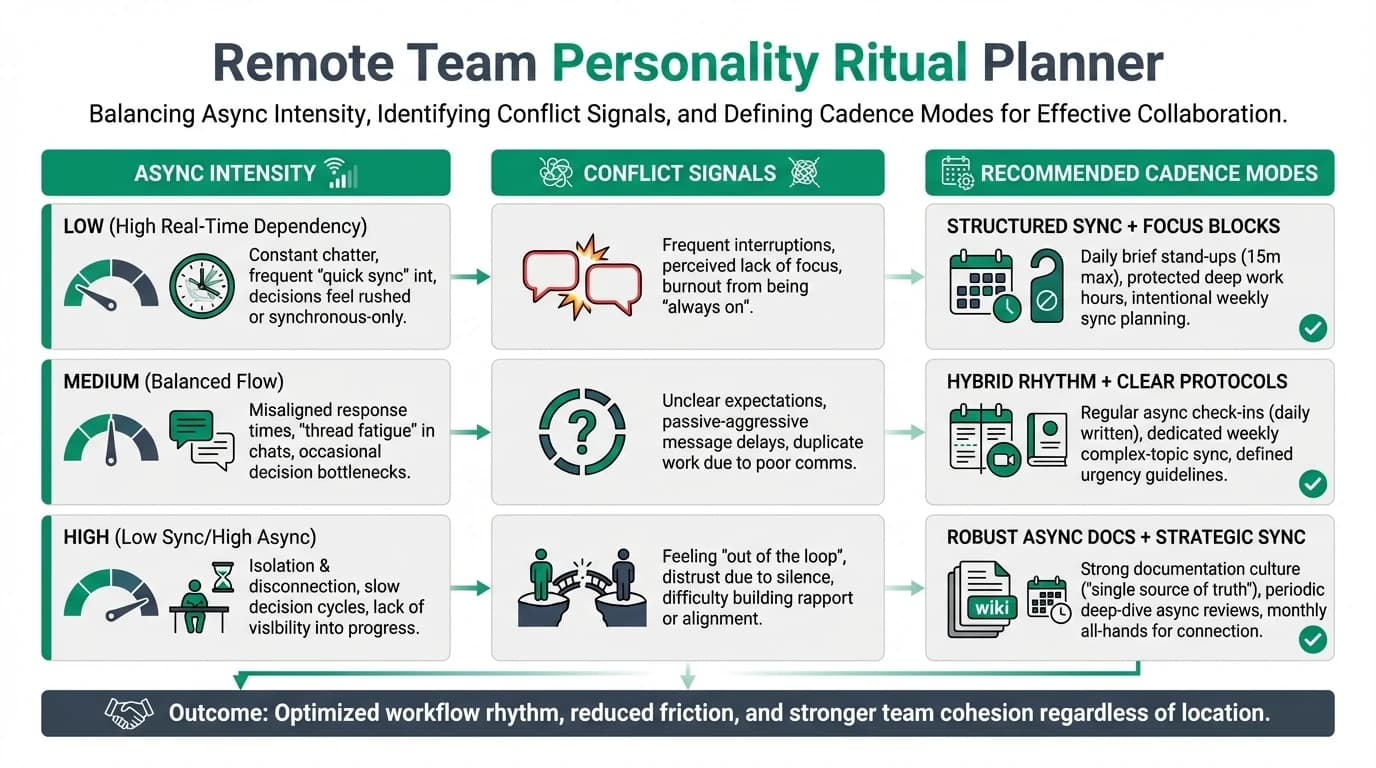
Build a personality-informed collaboration rhythm for remote teams using async load, conflict exposure, and remote density.
Quick answer
What does this planner optimize?
It recommends a practical ritual cadence and framework mix for remote teams based on coordination complexity and communication friction.
Source: IZA Institute of Labor Economics
Why this tool matters
Remote teams often apply generic rituals without considering communication load and profile diversity. This planner helps managers choose a right-sized operating rhythm.
Start with Personality Tests for Remote Teams, then calibrate profile interpretation with Big Five Personality Test: Complete Interpretation Guide.
Planner inputs
| Input | What it approximates |
|---|---|
| Remote team ratio | Coordination distance |
| Async intensity | Documentation and response latency pressure |
| Conflict exposure | Collaboration friction and repair needs |
Output model
The tool assigns a complexity score and recommends one of three operating modes:
- Lean playbook
- Hybrid playbook
- High-structure playbook
Each mode includes recommended review cadence and framework orientation (Big Five baseline, DISC overlays, or workshop language support).
Primary Sources
| Source | Type | URL |
|---|---|---|
| IZA Institute of Labor Economics | Remote productivity research | docs.iza.org/dp15486.pdf |
| Journal of Occupational and Organizational Psychology | Team and workplace behavior research | onlinelibrary.wiley.com/journal/20448325 |
| APA Dictionary | Five-factor model definition | dictionary.apa.org/five-factor-model |
Guardrails
Manager checklist
- Use this planner as a baseline, not a rigid rulebook.
- Validate recommendations with retrospective team outcomes.
- Keep psychological safety checks in every cadence loop.
- Re-run after major team composition changes.
FAQ
Should all remote teams run a high-structure playbook?
No. High structure is useful when async intensity and conflict exposure are both high.
How often should this planner be re-run?
At least quarterly, and immediately after major staffing shifts.
Which framework should be the baseline?
In most high-stakes decisions, Big Five remains a stable baseline.